Daytona USA 2: Battle on the Edge
Release Date - June, 1998 (JP)
Developer - Sega AM2
Publisher - Sega
Platform - Arcade (Sega Model 3)
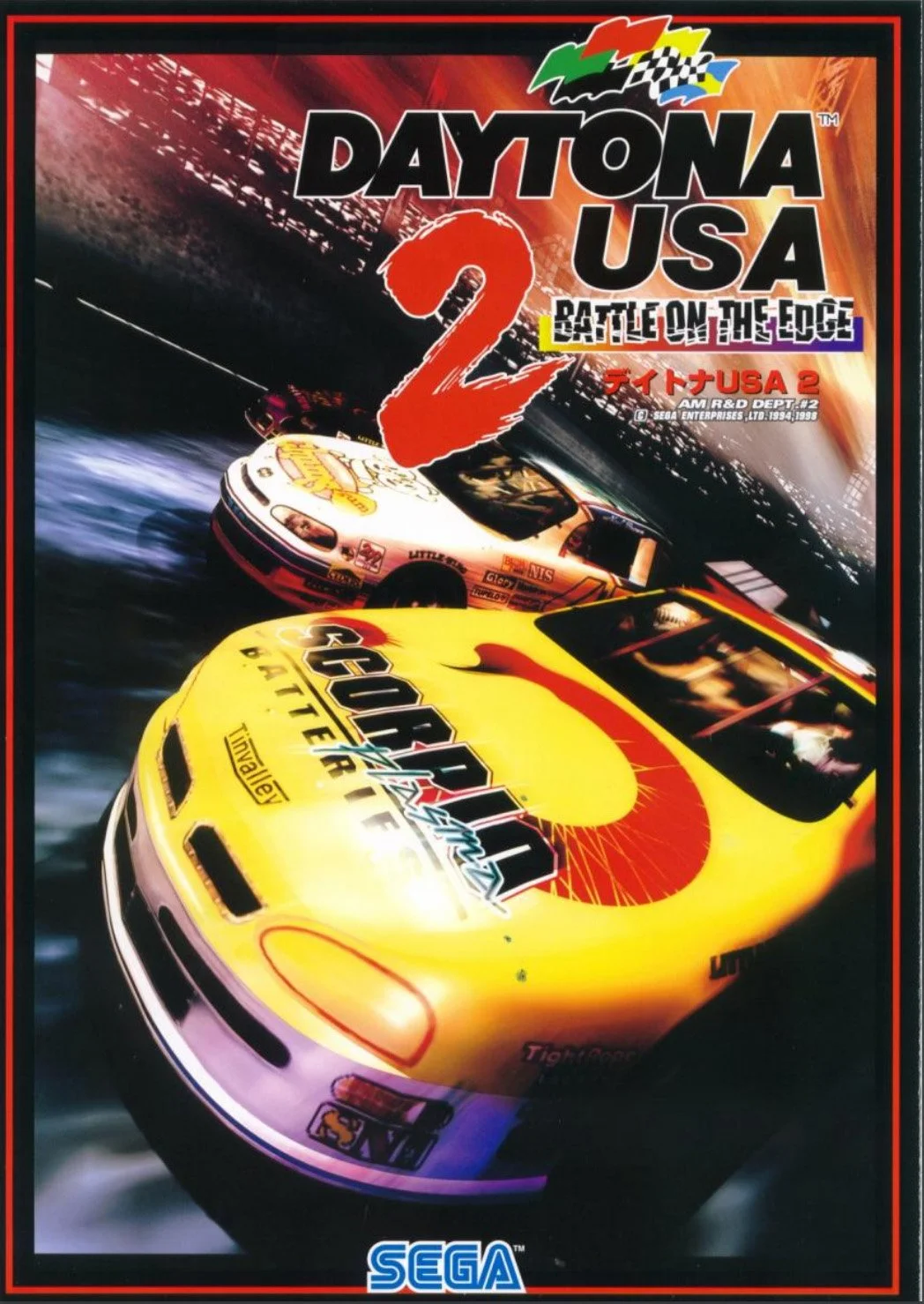
One of the most lauded and recognisable titles to ever hit the arcades is Sega’s legendary Daytona USA (1994). Four years and countless quarters later, Sega would release the long-awaited sequel. A whole new world of high-speed racing, blue skies and gorgeous graphics await…
Daytona USA 2 obviously had a very tough act to follow, but the team at AM2 worked hard to make sure gamers were not disappointed. While the original game was on the very impressive Model 2 arcade hardware, Daytona USA 2 would release on the even more powerful Model 3 (the arcade board that also hosted the incredible Virtua Fighter 3 (1996). The Model 3 already hosted a number of great games in 1998, including Sega Rally 2 and Fighting Vipers 2 so arcade goers would be spoilt for choice with Daytona USA 2 also arriving in arcades the same year.
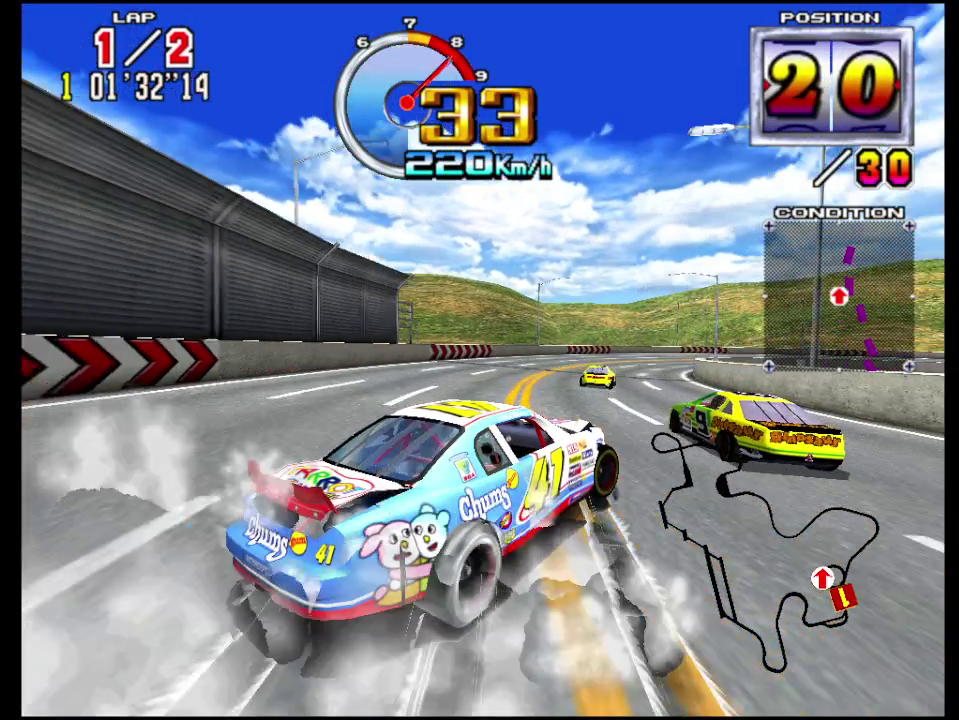
Burn those tyres too much and you might need to make a pit-stop.
As per the first game, Daytona USA 2 is all about NASCAR racing. Originally decided to focus on this by the first game’s director Toshihiro Nagoshi (of Yakuza/Like a Dragon fame) as this was an exotic concept for the Japanese market, the ‘Americana’ aspect of the first game is replicated here again. The NASCAR basis also means there’s plenty of other cars on the track, often feeling crowded (in a good way) and lots of high-speed banked turns and straights to really flex the car’s muscles.
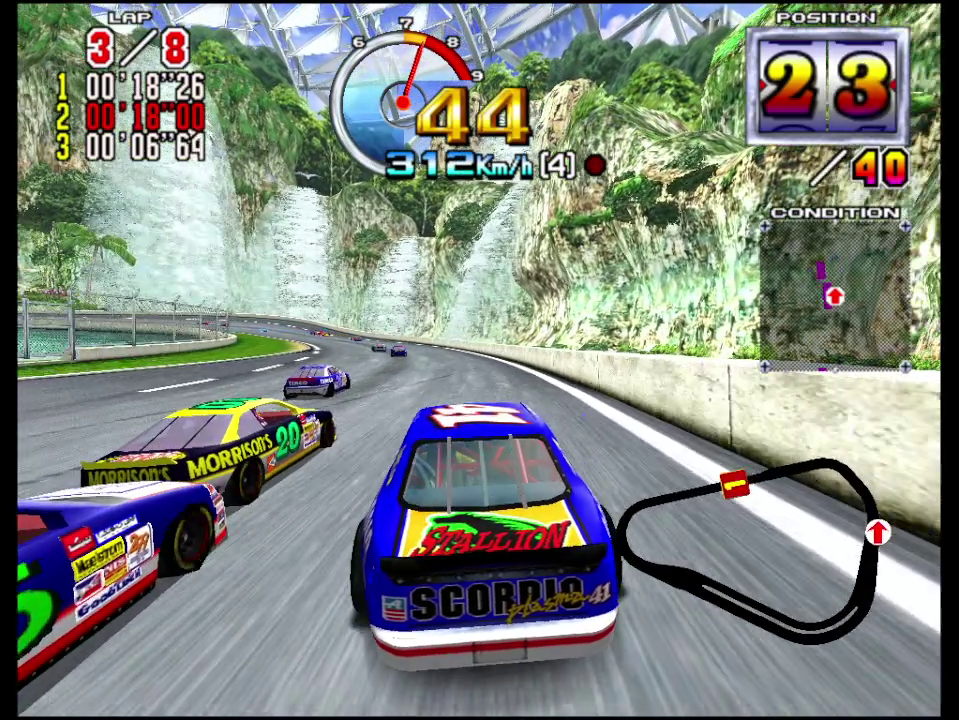
Yes, that’s forty cars on the track.
While the rules of most racing games will apply here, being careful with your racing line and applying brakes and the accelerator in the right measures, there’s also some particularlities to Daytona USA 2 to make it unique. Power-sliding returns from the first game, and can be achieved by either tapping brakes or down-shifting your gears before slamming back into a high gear. This sends your car sideways with the tyres spinning, allowing you to take corners at high speed - assuming you can keep control of the car! This isn’t quite accurate to the real life motor-racing strategies, but sure is fun to do. Opposite to this is the real-life strategy of ‘Slipstreaming’ or ‘Slingshotting’. This is where you drive behind another car, using them as a windbreak and gather speed in their slipstream. As you start to build speed, you quickly shift the car to the left or right and use the built up momentum to rocket past them at a high speed. This requires some careful control of the car to ensure you don’t rear-end them, and then the right timing to slip out from behind and overtake. It’s extremely satisfying when done right, and an important technique to get the best times and win races.
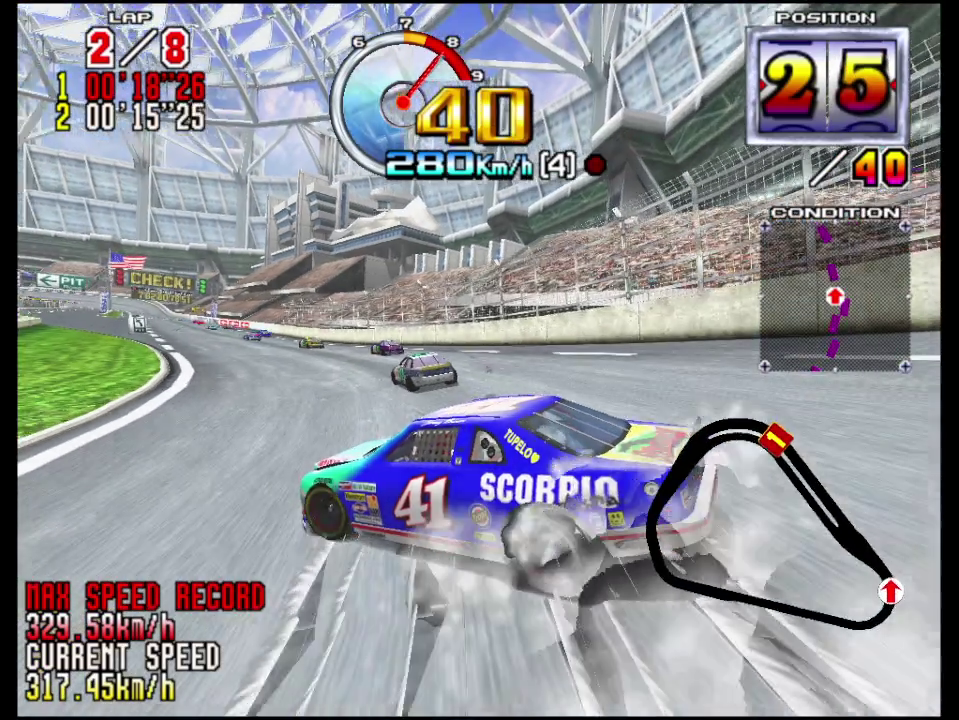
Powerslide to win races and influence people.
Before getting into a race, the player has to first select a car and transmission type. Transmission type is either automatic or manual, and no surprises here that manual requires to the player to shift gears themselves, but results in faster acceleration and top speeds over the simpler automatic option. On top of that, the player has three different cars to choose from, identified by their racing teams. The beginner car with the easiest handling but lowest top speeds is the Chums Gum racing team car. In the middle is the Scorpio Batteries racing team car, that starts to give a bit more ability to powerslide along with higher top speeds. Finally Phantom Racing team car can be quite challenging to handle, with it requiring lots of sliding and careful control, but players are then rewarded with the highest speed vehicle in the game. While three cars isn’t a huge amount, it's enough to allow players of all skill levels to experience the game, and slowly build their skills along the curve.
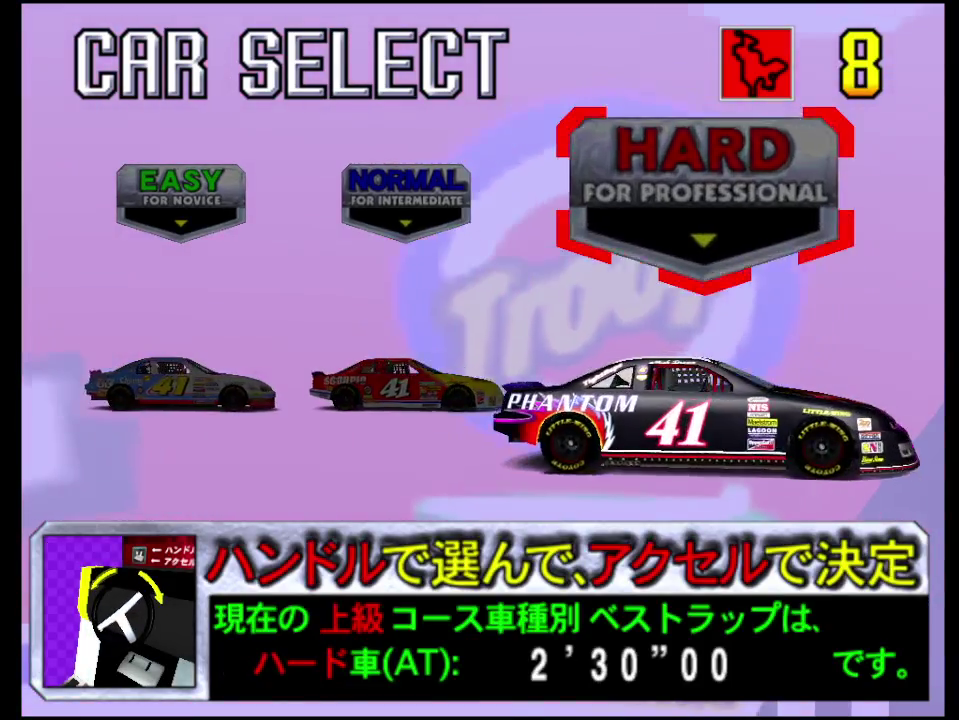
Three cars, two transmission types, what more do you need?
Beyond the player’s cars, the CPU controlled cars also have some interesting quirks. Unlike a lot of other racing games, you’ll see other cars on the track have collisions that range from small scrapes and bumps through to massive car crashes that result in cars flipping and spinning out. CPU cars in this game didn’t follow a standard ‘track’ or routine, but rather had acceleration, brakes and steering that could change with each race both due to player input or random variables. It meant that you got unpredictable events like a crash or aggressive driving from the CPU to add some variety and excitement. At the same time, the CPU controlled cars are programmed to try to avoid ‘unfair’ collisions with the player, so you won’t have them ramming you from behind where you can’t see the impact coming and ruin that perfect lap you were working on. It doesn’t seem like much on the surface, but the enhanced AI for the opposing cars makes for a much more involved experience than the original Daytona or other racers of the time.
On the topic of opposing racers, the original Daytona was such a huge success in no small part because it let you race seven of your friends by linking up to eight cabinets (assuming you could find seven friends…). Daytona USA 2 goes beyond that feat by doubling the number to sixteen! There was even an option to turn off all the CPU controlled cars so it becomes a totally mano-a-mano (x16) affair!
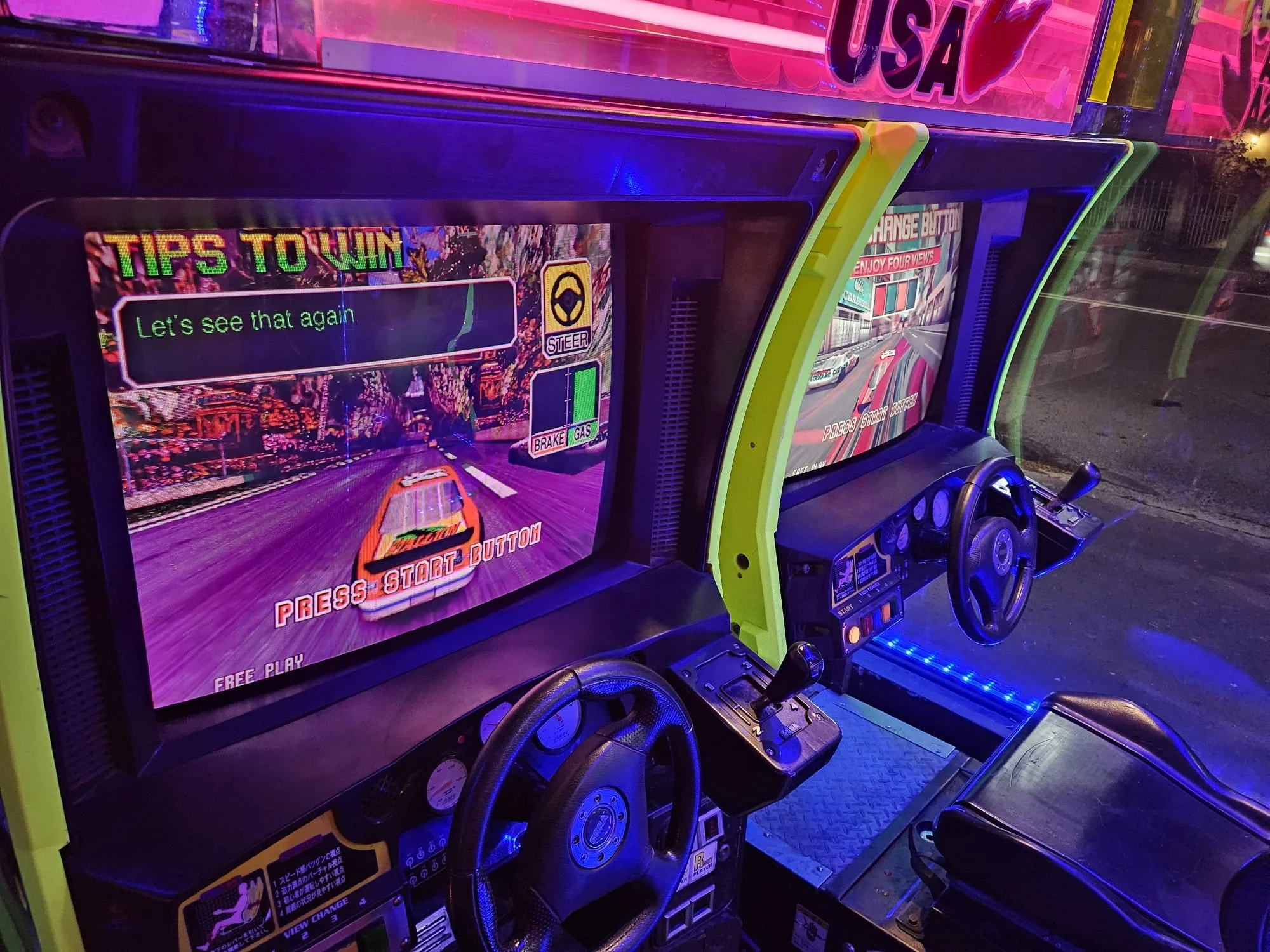
A Daytona USA 2 cabinet, in the flesh! Or, fake leather, I suppose…
Once you’ve chosen the car and transmission it’s onto the tracks. Much like the first game you have three tracks ranging from a simple oval to a complicated street racing circuit. The oval track is almost identical to the original game’s in terms of layout, but players will notice that Daytona USA 2 leans into a more stylised and ‘fantastic’ element more than the first game. The oval now takes place in some kind of ‘bio dome’ (thankfully Pauly Shore is nowhere to be seen), with lush tropical plants, birds and waterfalls in the center of the track, with spectators surrounding it. It’s certainly a sight to see on the all-powerful Model 3 board which just pumps out some incredible graphics. This beginner track is very much about hitting that top speed and learning the mechanics like slingshotting; it’s just a couple of left-hand turns and you really don’t need to brake at all, just learn the racing line and make sure you avoid collisions as best you can. It’s a good way to ease into the game and learn the car and mechanics. It’s worth noting that in the Power Edition of Daytona USA 2 (also releasing in 1998), the track was altered to look a lot more like a traditional NASCAR track. This release also made some other minor changes to CPU behaviour and some minor track changes, but the change to the Beginner oval is the most notable. Which is best will come down to player preference and whether they want the feeling of being at a real track, or something more wild!
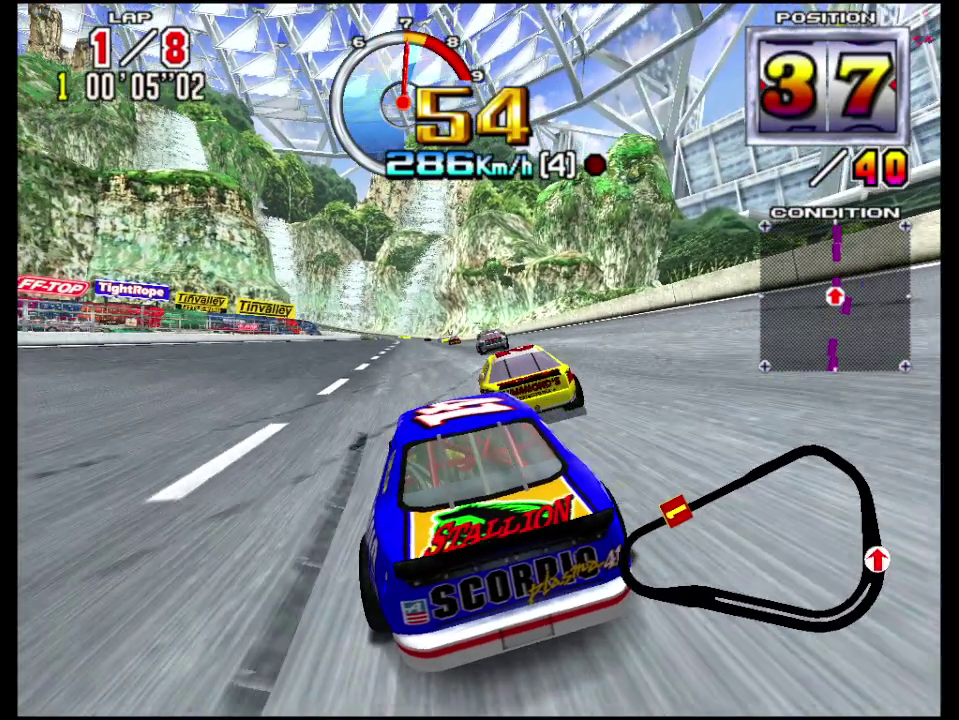
Look at those waterfalls! Now you’re just showing off, Sega…
The ‘Intermediate’ track is even more wild, with it taking place in a theme park (maybe? It’s hard to tell at 300 km/h) complete with a swinging pirate ship ride at the start line, gigantic animatronic skeletons (that shoots lasers from their eyes) and snow and desert themed areas. It’s delightfully ridiculous and really feels like the developers are showing off. Having said that, you won’t have much time to appreciate the background in great detail, as unlike the beginner oval, this track has a number of tricky turns that require careful braking and/or powersliding to navigate. The difficulty is considerably higher, and the track is a lot longer.
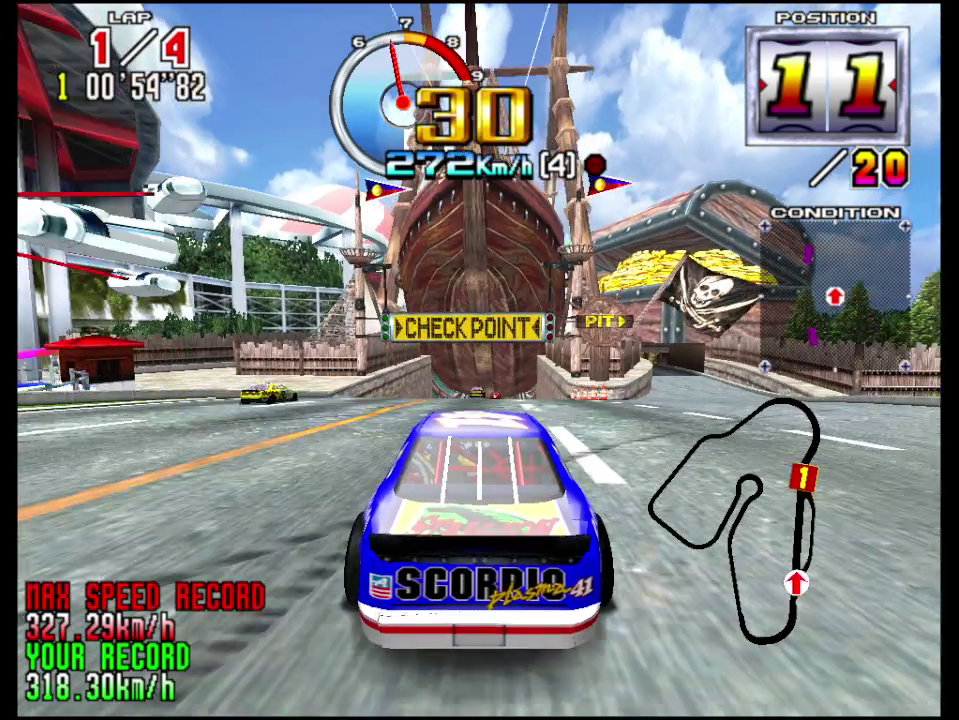
That’s a giant, swinging pirate ship. Wait until you see the pit-crew for this track!
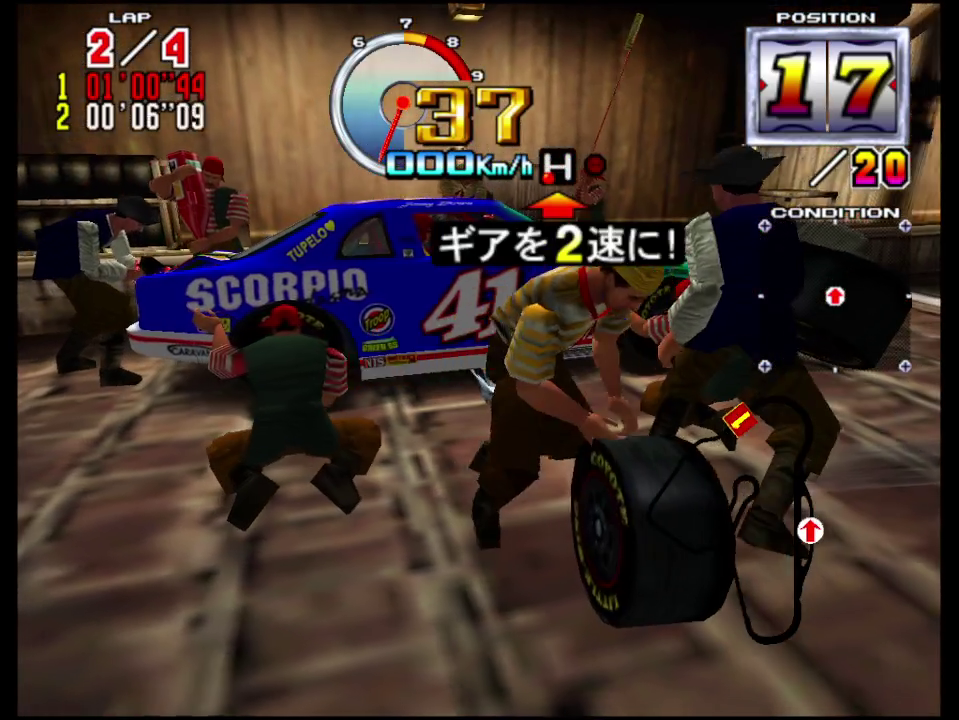
The pit-crew are dressed as pirates! Such a nice touch, they didn’t have to do that…
Finally, the expert track is the most grounded, but also the most difficult. The track is quite long, which means memorising it all won’t be easy, but also means there’s only two laps! Not much time to make up for a bad turn or collision! While the scenery isn’t wild like the first two tracks, it’s still beautiful and a nice change of pace to be street racing in what seems like a relatively real place. Well, ‘real’ if you could picture an idealised city with permanent blue skies, green grass and impeccably clean streets! According to director Makoto Osaki, the cars in Daytona USA 2 had about five times the polygons used for cars in the original game. A good indicator of just how much a graphical leap was achieved between the games in only four years!
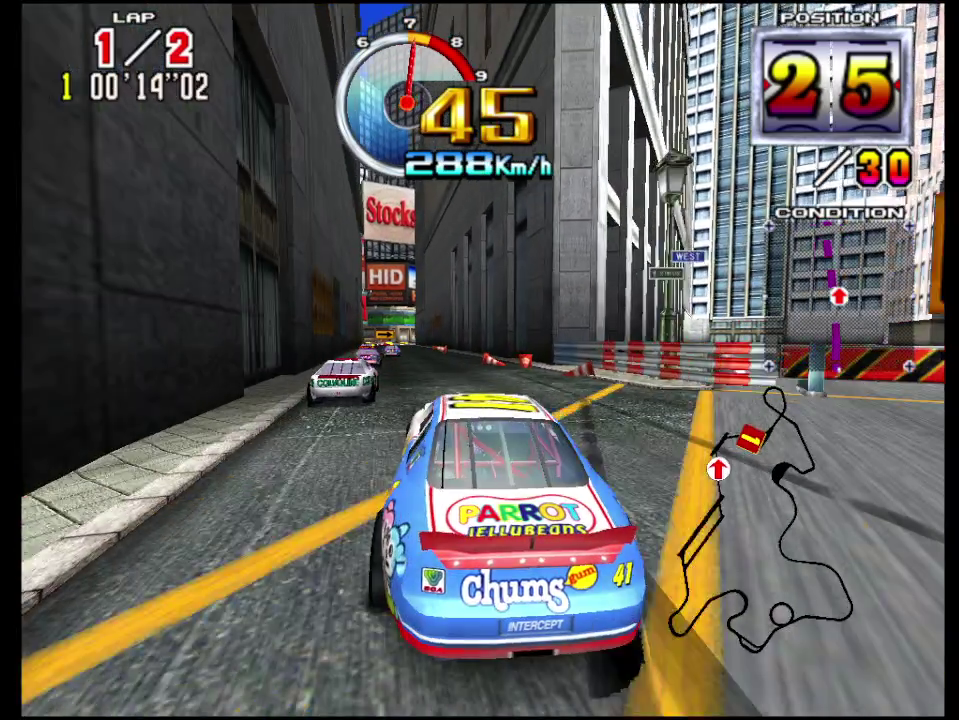
Weaving through city streets at 288km/h, not for the faint of heart.
In a neat touch there are a lot of different view points to enjoy the game’s graphics from too. Along the usual chase and hood variations there’s also a semi-hidden ‘Driver’s Eyes’ view point where you see the action from inside the car, complete with the dashboard, steering wheel and the driver’s arms moving during the race! This viewpoint obscures a lot as you have the windshield frame, roll cage and the like blocking some of the view, but damn if it doesn’t look awesome and immersive.
The sound design matches the graphics, with some excellent sound effects to indicate the roaring engines and squealing tyres. The announcer is great too, getting incrementally more excited with each lap as he indicates time extensions to the player. The arcade cabinets doubled down on this, with big speakers and even vibrations in the chair to give players the sensation of the engine roar and collisions. The music isn’t as memorable as the original game (but let’s be real, there’s probably no more iconic theme in arcade gaming than the legendary Daytona theme), but it is still great. It again features vocal tracks and a very upbeat and fun soundtrack to match the rest of the aesthetic.
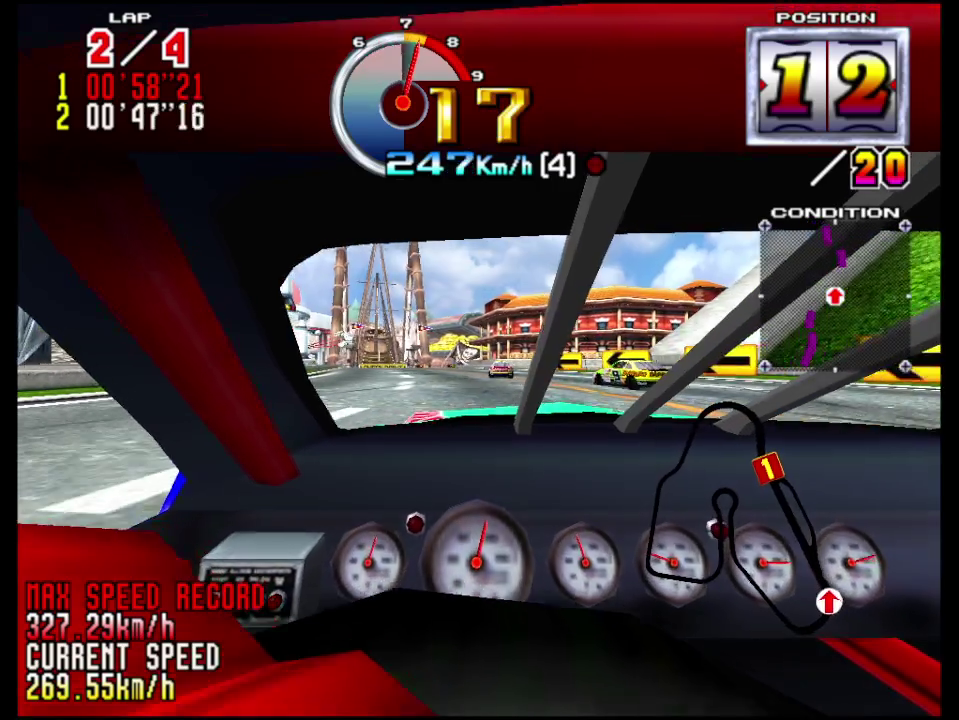
The ‘driver’s eye’ view adds a whole new layer of challenge.
All in all Daytona USA 2 has all the hallmarks of a classic Sega arcade racer; simple on the surface but deceptively deep and rewarding, all wrapped up in an utterly gorgeous package. While there may only be three cars and three tracks, the true depth in this game lies in the mastery and getting first place on any of the tracks, let alone all three will take many, many hours and dedicated practice. Racing fans will do well to check this one out for a spin!
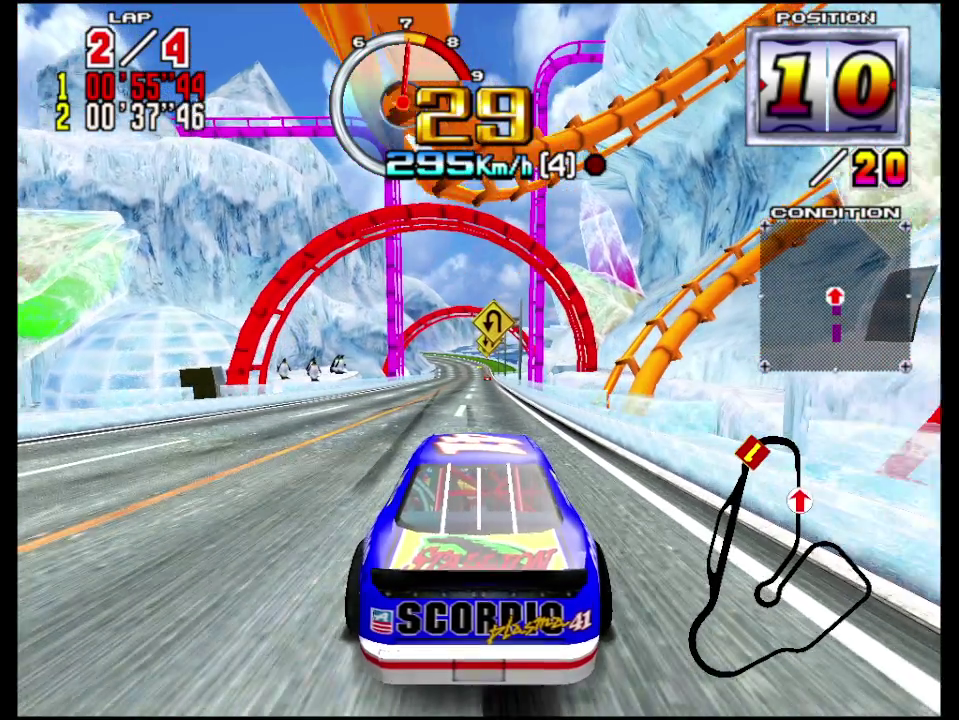
A sim-racer this isn't, this game is all about arcade fun.